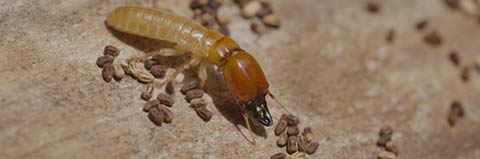
Broad body, straight antennae
- No sharply pinched waist between the thorax and abdomen.
- Antennae appear straight or beadlike rather than elbowed.
- Front and hind wings are approximately the same length.
Learn how to read pellets, wings, galleries, and wood damage—then use a professional inspection to determine what the evidence actually means.
Call (619) 421 - 2101Drywood termites are established throughout Southern California and can infest structural framing, eaves, fascia, door and window frames, fences, decks, patios, furniture, and other above-ground wood. Unlike subterranean termites, they establish colonies inside the wood they consume and do not need a connection to soil. A painted or otherwise intact surface can conceal galleries until pellets, discarded wings, swarmers, or damage become visible.
The western drywood termite, Incisitermes minor, is the drywood species most often associated with California structures. It belongs to the family Kalotermitidae. Finding something that resembles termite evidence is a reason to investigate, but it does not reveal the full location, age, or activity of an infestation. A licensed termite inspection process evaluates the visible and accessible evidence before treatment or repair decisions are made.
Not sure whether the evidence is new or old?
Schedule an inspection →Termite and ant swarmers can appear similar at a glance. Compare body shape, antennae, and wings together; the month or time of a swarm is not a dependable identification test.
If the insects are ants, their nesting and control needs are different. See our ant extermination services for common San Diego ant activity.
Drywood termites use gradual development rather than the egg-larva-pupa-adult sequence seen in ants. They also lack a permanent true-worker caste. Flexible immatures called pseudergates, along with nymphs, feed colony members, maintain galleries, and may later develop into other roles.
Winged male and female reproductives leave a mature colony. Most do not establish a new colony.
A successful pair sheds its wings, enters a suitable crack or opening, and begins a chamber in wood.
The king and queen care for the earliest young until colony members can feed and maintain galleries.
Pseudergates and nymphs perform work while retaining the ability to develop into other colony roles.
Soldiers defend the colony, and some nymphs eventually develop into new winged reproductives.
No single clue maps every concealed gallery. The strongest assessment comes from considering where the evidence appears, whether it is recurring, and what the surrounding wood reveals.
Dry, hard pellets may collect in small piles below a kick-out opening. Their color can vary with the wood being consumed.
Small surface openings allow colony members to push accumulated pellets out of their galleries.
Loose, similarly sized wings near windows, sills, attics, or wood joints may remain after reproductives settle.
Winged termites emerging from a structure are important evidence, but the emergence point may not show every colony location.
Blistering, a hollow response when professionally sounded, or a thin remaining surface may indicate concealed feeding damage.
Opened wood may reveal chambers that cross the grain, with smooth surfaces and pockets of characteristic pellets.
What it can show: Drywood termite pellets are hard, elongated, rounded at the ends, and marked by six flattened sides with longitudinal ridges. A pile beneath a kick-out hole is a useful location clue.
What it cannot show: Pellets alone cannot confirm whether activity is current, how far galleries extend, or whether other colonies are concealed elsewhere. Old pellets can shift after vibration or previous work.
Colonies remain within relatively dry, sound wood and usually have no soil connection. Six-sided pellets, kick-out holes, discarded wings, and clean galleries are common clues.
These termites live in or connect to soil and commonly travel through earthen shelter tubes. Their biology and treatment are different from drywood termites. Review our subterranean termite control information.
Dampwood termites favor wetter or decayed wood. Correcting leaks, decay, or other moisture conditions is central to resolving the affected material.
Because termite types require different approaches, identification should come before choosing any termite control service.
Swarmers can enter small joints and openings, so inspection must connect the evidence to the architecture rather than assume activity is limited to the first visible pile of pellets.
Protected joints, exposed end grain, and concealed framing can provide entry and gallery locations.
Wood trim, corners, and joints can hide kick-out holes, wings, or localized damage.
Weathered coatings and exposed wood connections deserve attention during an exterior inspection.
Infested fences, dead limbs, or stored lumber can support separate colonies near a structure.
Drywood termites can arrive in infested wooden items and are not limited to structural framing.
Posts, sill areas, and framing may be susceptible; concrete itself is not food and should not be described as termite damage.
Do not improvise a long-handled sharp tool to poke eaves, decks, or overhead framing. Elevated work, damaged wood, wiring, and concealed construction conditions can create hazards.
Discuss pellets, wings, swarmers, prior reports, treatments, repairs, and where evidence has returned.
Examine visible interior, exterior, attic, and exposed-wood locations within the agreed inspection scope.
Compare pellets, kick-out holes, galleries, wings, wood changes, and possible carpenter-ant or beetle evidence.
Consider accessibility, likely colony boundaries, concealed areas, and the condition of affected wood members.
Recommend monitoring, localized treatment, whole-structure treatment, or repairs according to the findings.
A visual inspection of accessible areas cannot promise discovery of every concealed colony. Learn more about our termite inspection process or call with questions about your property.
Drywood termites excavate chambers while leaving portions of the wood surface intact. Damage can be limited to a small piece of trim or extend into framing, posts, and other important members. Significance depends on the member, the extent and location of galleries, the amount of sound wood remaining, and whether the component carries a structural load.
Repair may involve removing, replacing, reinforcing, or otherwise addressing affected material after the infestation has been evaluated. Potentially significant damage should be reviewed by an appropriately qualified professional. Explore our structural repair services for related information.
Compare our dedicated drywood termite treatment page and broader termite treatment methods. Any pesticide application must use an appropriately registered product according to its label and applicable licensing requirements.
Maintain paint, finishes, and sealed joints where appropriate, paying attention to end grain and weathered trim.
Keep vent screening intact and repair accessible gaps without blocking required ventilation or drainage.
Check used furniture, lumber, cabinets, and reusable wood for pellets, wings, openings, or unexplained damage.
Monitor fences, stored lumber, dead limbs, and other wood that shows evidence near the structure.
Repair leaks and deteriorated coatings while remembering that drywood termites do not require wet wood.
Properties with prior findings or recurring evidence may benefit from documented follow-up inspection.
Use these answers as a starting point. Evidence inside a finished structure still needs to be interpreted in the context of the property.
Drywood termite pellets are dry, hard, rounded at the ends, and have six flattened sides with lengthwise ridges. Color varies, and magnification may be needed to distinguish them from ordinary debris or evidence from another wood-destroying pest.
No. Pellets can remain from prior activity or move after vibration and repairs. Their location is useful evidence, but recurring pellets, other signs, and an inspection are needed to evaluate whether activity appears current.
Winged termites have a broad waist, straight or beadlike antennae, and front and hind wings of similar length. Winged ants have a narrow waist, elbowed antennae, and shorter hind wings.
No. Their colonies can remain entirely inside relatively dry, above-ground wood. This separates them from soil-associated subterranean termites and moisture-associated dampwood termites.
No. Localized treatment depends on finding and reaching every target colony. When walls, finishes, or multiple areas conceal the infestation, an inspector may discuss broader treatment options and their tradeoffs.
It may be considered when evidence indicates widespread, multiple, or inaccessible drywood termite infestations. The recommendation should come from the inspection findings rather than one pellet pile or isolated damaged board.
We can inspect visible and accessible evidence, discuss what it means, and recommend the next appropriate step for your San Diego property.