

Drywood termites
Colonies live inside relatively dry wood without routine soil contact. Depending on distribution and access, recommendations may include localized gallery treatment, removal of affected wood, repairs, or whole-structure treatment.
Compare localized treatment, fumigation, soil treatment, baiting, corrective work, and prevention by the termite and evidence actually found.
A useful termite recommendation begins with identification. Drywood termites live inside above-ground wood, subterranean termites usually connect to soil, and dampwood termite activity often points to persistently wet or decayed wood. The method that reaches one type may completely miss another.
A licensed termite inspection evaluates visible and accessible evidence, distribution, construction, soil access, moisture, previous work, and damaged members. Those findings help determine whether the appropriate scope is localized, whole-structure, soil-based, bait-based, corrective, preventive, or a combination.
Preparation and convenience matter, but they cannot replace coverage. A less disruptive option is useful only when it can address the identified activity. Likewise, a broader treatment should not be recommended merely because it is familiar. GC Termite Control explains the target, treated locations, access limitations, pesticide precautions, and follow-up before authorized work begins.
Need help comparing treatment scopes?
Call (619) 421 - 2101 →A treatment name alone does not show whether it can reach the reproductives, workers, galleries, or soil network supporting the infestation.
Colonies live inside relatively dry wood without routine soil contact. Depending on distribution and access, recommendations may include localized gallery treatment, removal of affected wood, repairs, or whole-structure treatment.
Foraging termites commonly travel from soil through shelter tubes, foundation joints, bath traps, or utility penetrations. Liquid soil treatment, professional baiting, targeted supplemental work, and moisture correction may be combined.
Dampwood termites are associated with high-moisture wood. Correct identification, leak or moisture correction, and evaluation of decayed material may be more important than copying a drywood or subterranean treatment plan.
Local treatment is directed at identified wood, galleries, tubes, soil-access points, or another documented area. Its advantage is focus. Its limitation is that concealed or separate infestations outside the treated area can remain.
A properly performed whole-structure method treats accessible and inaccessible areas within the treatment envelope. Structural fumigation is less dependent on locating every drywood gallery, but requires broader preparation and temporary vacancy.
The California Structural Pest Control Board distinguishes local treatment from an all-encompassing treatment. An inspection report and proposal should make the intended coverage understandable before the owner chooses a method.
Drywood treatment selection depends on how confidently the activity can be located, how many areas are involved, and whether the affected wood can be reached.
The structure is enclosed and a registered fumigant penetrates exposed and concealed spaces. It may be considered for widespread, inaccessible, or multiple drywood infestations.
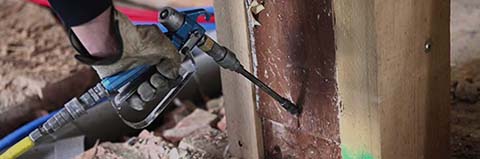
A registered product may be drilled, injected, foamed, or otherwise applied to located galleries or accessible infested wood according to its label and the approved treatment scope.
GC uses XT-2000 as its primary orange-oil product for suitable localized findings. Its 95% d-limonene active ingredient is applied into identified, accessible drywood termite galleries.
Accessible infested or damaged material may require removal, reinforcement, or replacement. Corrective work physically addresses the member but does not establish that every nearby colony was found.
Fumigation intended for drywood termites generally does not reach the subterranean reproductives and foraging network in soil. These infestations require a different plan.
Depending on construction and the label, treatment may involve trenching, rodding, or injection beside or beneath concrete. GC records include Termidor SC, containing fipronil, and Altriset, containing chlorantraniliprole.
No universal depth, spacing, volume, duration, or colony outcome applies to every property.Slow-acting bait in a cellulose matrix is placed where foragers can encounter and share it. Station discovery and program progress vary with species, season, soil, competing food, placement, and monitoring.
Bait is a serviced treatment system, not a one-time stake or predictable calendar.Above-ground bait, foam, liquid, or another registered application may support a broader plan when active tubes, accessible voids, or localized routes are identified.
Supplemental work does not replace the soil or nest strategy when that connection remains active.Properly graded particles, stainless-steel mesh, shields, treated materials, or labeled preconstruction systems can protect vulnerable construction details.
Incomplete installation, later penetrations, and untreated access routes can reduce performance.This overview helps frame the conversation. The actual proposal must reflect the inspection, product label, construction, and documented target area.
| Method | Primary target | Coverage and access | Main limitation | After treatment |
|---|---|---|---|---|
| Localized drywood treatment | Located drywood galleries | Selected accessible wood | Detection and access determine coverage | Monitor treated and previously inaccessible areas |
| Whole-structure fumigation | Drywood termites in the enclosed structure | Accessible and concealed areas inside the treatment envelope | Preparation, vacancy, and no residual prevention | Continue prevention and future inspection |
| Liquid soil treatment | Subterranean soil-to-structure routes | Label-permitted soil and construction zones | Construction, soil, drains, wells, and access affect the plan | Inspect tubes, moisture, and untreated routes |
| Professional baiting | Foraging subterranean termites | In-ground or above-ground serviced stations | Termites must encounter and consume the bait | Ongoing servicing and monitoring are essential |
| Repair or physical barrier | Damaged material or vulnerable access | Specific members and construction details | Does not prove every active colony was treated | Maintain barriers, finishes, and corrected conditions |
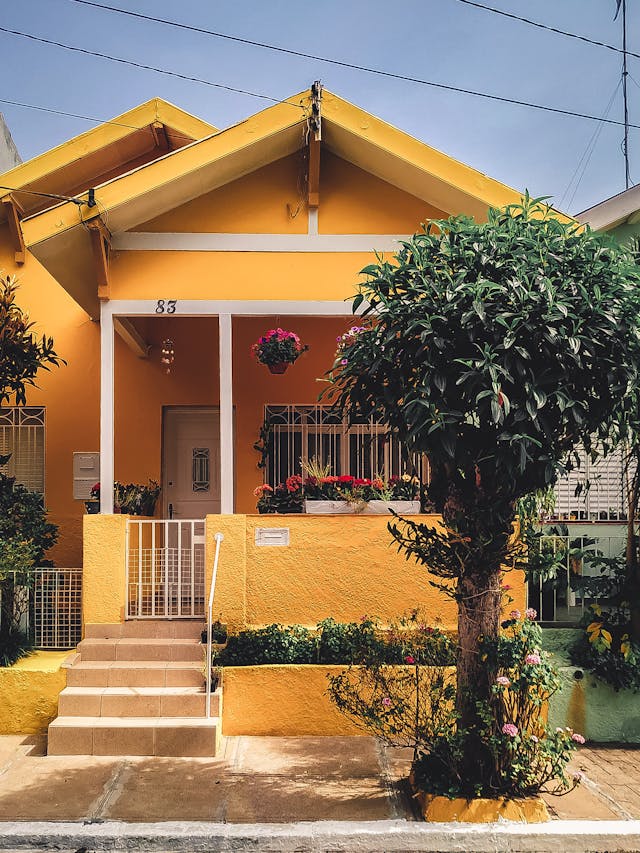
Termites found in an exposed fascia board present a different access problem from evidence behind a finished wall, beneath a slab, across shared framing, or in several roof zones. The building is part of the diagnosis.
These industry methods are included for education and are not presented as services automatically available from GC Termite Control.
Heat must reach and hold a lethal temperature inside all target wood. Heat sinks, finishes, contents, construction, and access can affect whether the target area is treated evenly.
Microwave energy can heat a localized area, but accurate detection is critical and building materials can interfere. Surface or interior wood damage is possible.
These are localized techniques rather than automatic whole-structure solutions. Equipment access, target location, adjacent materials, and the ability to verify coverage matter.
Some registered borate products can be applied to compatible unfinished wood. Coatings, weather exposure, application access, and the current label determine their role.
Retail stakes can miss activity or provide incomplete information. Professional baiting requires placement, servicing, and monitoring, while soil termiticides require trained, label-compliant application around building systems and environmental pathways. Store-bought surface sprays do not provide whole-structure termite control.
Ultrasonic or electromagnetic plug-in devices should not be treated as substitutes for established termite management. The Federal Trade Commission has challenged unsupported claims that ultrasonic products eliminate insects or replace conventional pest control.
Registered termite products are selected to affect target pests. They should not be described as harmless merely because an active ingredient is botanical, a finished application has little odor, or the product uses a lower amount of active ingredient than another method.
The proposal should identify the target pest, product or method, treated locations, and areas that remain outside the work.
PPE, occupants, pets, ventilation, re-entry, ignition sources, food, water, drains, ducts, wells, and surfaces are handled according to the label and site.
Rates, concentrations, drilling, injection, soil volumes, and placement belong to the registered label and trained technician—not a generalized web guide.
Confirm the termite, evidence, visible damage, and accessible areas rather than choosing from a photograph alone.
Evaluate distribution, gallery access, soil routes, moisture, construction, previous work, and affected members.
Review localized, whole-structure, soil, bait, repair, physical, preventive, and combined options that fit the findings.
Document treated locations, preparation, label precautions, exclusions, access limitations, and follow-up expectations.
Complete the approved scope, record the work, and evaluate new evidence or conducive conditions after service.
Repair plumbing, roof, drainage, and irrigation issues that wet wood or foundation areas.
Maintain practical wood-to-soil clearance and remove buried or stored wood debris near the structure.
Maintain compatible finishes and evaluate unfinished, weathered, or damaged exterior wood.
Avoid concealing foundation edges with soil, stucco, vegetation, storage, or other materials.
Repair screens and practical gaps without blocking required ventilation, drainage, or equipment access.
Check used furniture, lumber, cabinets, and reusable wood before bringing them into a structure.
Photograph pellets, wings, tubes, or damaged wood before cleanup so the location can be evaluated.
Previous activity, inaccessible areas, and conducive conditions may justify follow-up inspection.
The correct answer depends on the organism, locations, access, and intended treatment scope. These answers provide comparison context, not a property-specific diagnosis.
A licensed inspection identifies the termite, maps visible and accessible evidence, reviews construction and previous work, and evaluates damage, soil access, moisture, and concealed areas. Those findings determine which treatment categories can reach the activity.
Localized treatment addresses a defined target area and depends on locating and reaching the infestation. Whole-structure treatment addresses the treatment envelope, including concealed locations, but requires broader preparation. Local work should not be represented as automatic whole-structure coverage.
No. Limited, accessible activity may be a candidate for localized treatment or corrective work. Widespread, multiple, or inaccessible findings may support fumigation. The inspection and desired coverage determine the recommendation.
Liquid treatment addresses label-permitted soil or construction zones, while baiting relies on foraging termites finding, consuming, and sharing slow-acting bait. Some properties may use one method; others may benefit from a combined plan.
No pesticide should be described as harmless because it comes from a botanical source. XT-2000 is a registered localized termiticide with label precautions. Product origin does not determine whole-structure coverage or eliminate exposure controls.
Retail monitors may provide limited information, but they do not map every infestation. Soil treatment and professional bait systems require trained selection and service. Unsupported ultrasonic or electromagnetic claims should not replace established inspection and treatment methods.
We can inspect visible and accessible areas, explain which methods can reach the activity found, and prepare a property-specific treatment or repair recommendation.